

3rd March 2025, HRI 2025 Conference, Melbourne
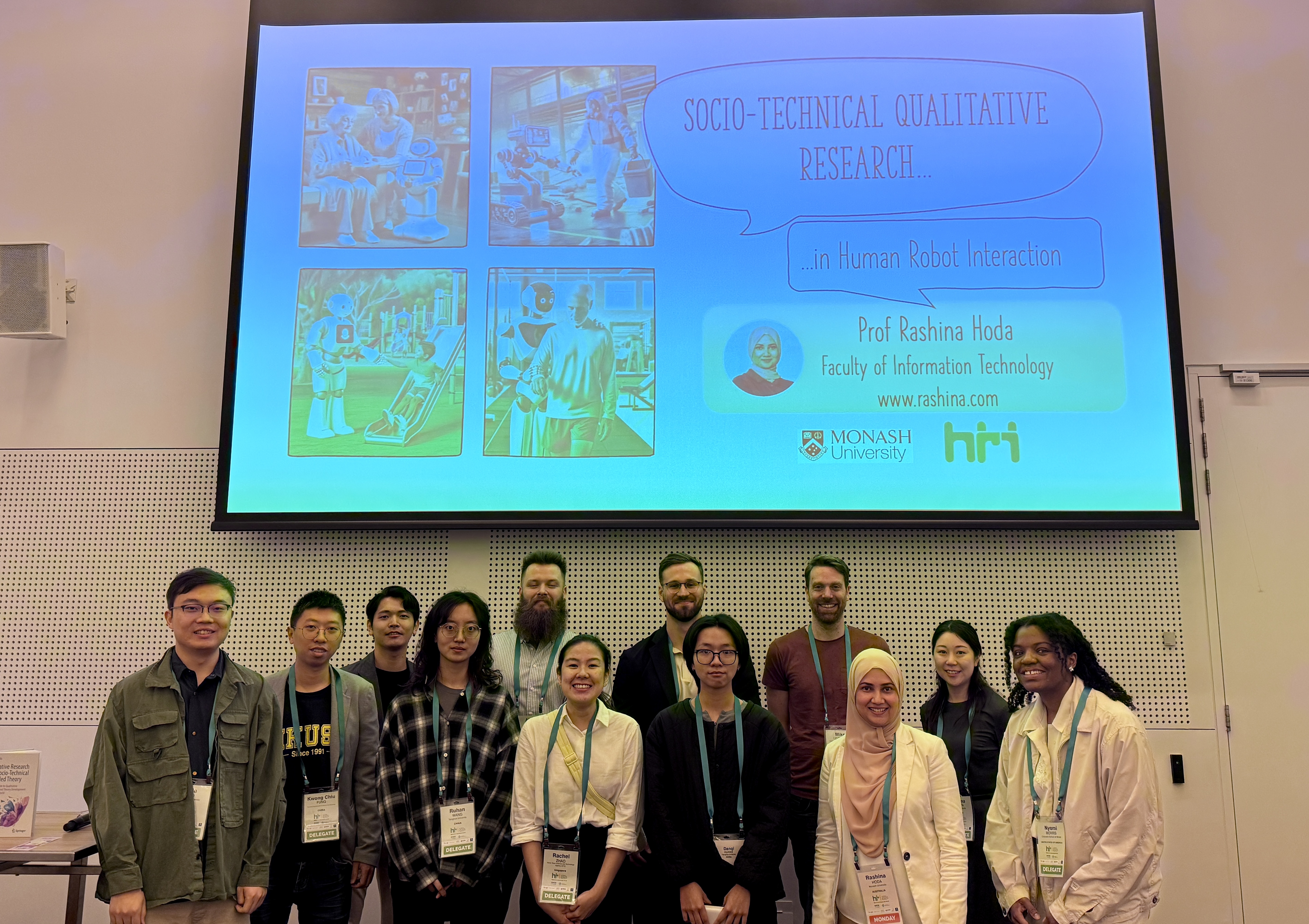
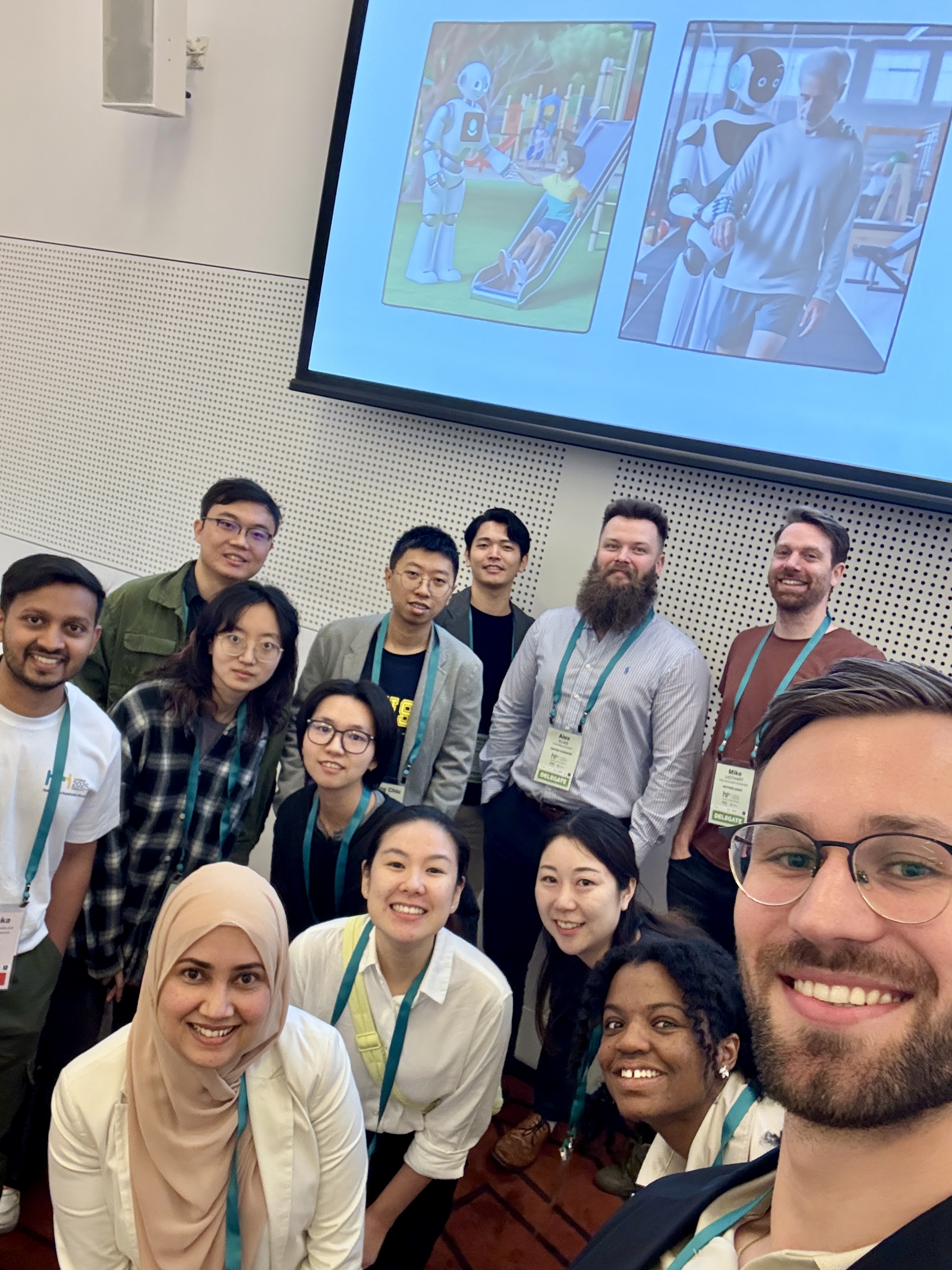
Photos from the Tutorial, HRI 2025
Tutorial Overview
The study of human factors, interaction aspects, and societal issues is an important part of human robot interaction (HRI) research. Qualitative research methods and procedures are well suited to these aims. However, there is room for improvement in the quality of their applications and outcomes in HRI research. Researchers often borrow qualitative methods from social sciences, attempt to adapt them, and risk incomplete inquires and poor applications in HRI. This tutorial will introduce socio-technical grounded theory (STGT), a modern version of the social science grounded theory methods, customised to study socio-technical domains such as HRI, where human and interaction
aspects are closely intertwined with the technical aspects. The tutorial will equip HRI researchers with foundational knowledge and skills to boost their qualitative research applications and share examples and resources to enable them to produce rich findings and robust outcomes.
Who Should Attend
In general, the tutorial will be useful for HRI researchers conducting all types of qualitative studies or those working with qualitative data within mixed methods research studies. It will be suitable to researchers with all levels of experience with qualitative data analysis including those looking to attempt it
for the first time.
In particular, the tutorial will be especially relevant for HRI researchers: conducting studies with human participants; those exploring human-robot, human-human, and robot-robot interactions; those studying societal and sustainability aspects (e.g., waste reduction, efficiency improvements, and address-ing global challenges); those focusing on community engagement to improve equity and inclusion of underrepresented groups; those studying human-robot interface design, human values (e.g., universalism, benevolence, security, power), human aspects (e.g. emotions, empathy, personality, motivation), and social aspects (e.g., social responsibility, ethics); and those
conducting evaluations of usability and user experience.
Tutorial Schedule
| 09:00-09:05 | Arrival |
| 09:05-09:20 | Welcome + Introduction STGT in HRI |
| 09:20-10:30 | Qualitative Research in a Socio-Technical World + Q&A |
| 10:30-11:00 | Tea/Coffee Break |
| 11:00-12:20 | Qualitative Data Analysis using STGT + Q&A |
| 12:20-12:30 | Resources + Wrap up |
Learning Outcomes
Through active participation, the tutorial participants will be able to:
- Understand the socio-technical qualitative research framework as it applies to qualitative research in HRI,
- Identify the differences between a full qualitative study and qualitative data analysis within mixed methods research,
- Identify different types of qualitative data, e.g., existing or custom collected across physical, virtual, and extended realities,
- Identify different qualitative data collection techniques, e.g., observations, interviews, surveys, interaction logs, simulations etc.,
- Assess the quality of qualitative data for inclusion in research studies,
- Apply STGT’s data analysis techniques of open coding, constant comparison, and memoing for making sense of different types of qualitative data,
- Learn to progress from first, often unsatisfactory, attempts to satisfactory and good qualitative data analysis,
- Derive rich, socio-technical codes, concepts, and categories, and
- Understand different expected outcomes, e.g. rich descriptive findings, insights, taxonomies, theoretical frameworks, and theories, through several examples from published studies.
Relevant Study Materials
Visiting some of the following materials ahead of the tutorial will enable an improved experience. However, this is not a pre-requisite and participants can also go through these as follow up materials after the tutorial.
- Reading the book, “qualitative research with socio-technical grounded theory” [1],
- Reading the TSE article “socio-technical grounded theory for software engineering” [2],
- Reading the empirical studies that have applied STGT in HRI [3], [4], including qualitative study of reactive synthesis in a simulated experiment of robot control [5],
- Watching videos of previous tutorials/technical briefings and other presentations on the topic. These links and materials are available at: http://www.rashina.com/stgt.
Tutorial Presenter

Rashina Hoda is a Professor of Software Engineering and Associate Dean of Equity, Diversity, and Inclusion at the Faculty of Information Technology, Monash University. She is an expert in qualitative empirical research and developed Socio-Technical Grounded Theory (STGT), a modern extension of sociological Grounded Theory.
With nearly 20 years of experience, she investigates the human and socio-technical aspects of software engineering and artificial intelligence. Rashina has published over 150 research outputs, been awarded over $5M in research funding, received multiple awards including being named the Top Australian Researcher 2025 in Software Systems, and serves as an Associate Editor of IEEE Transactions on Software Engineering. A champion for women in STEM and a recipient of the Guiding Star Mentorship award at the Women of Colour in STEM awards, she frequently shares insights at conferences, industry events, and public platforms such as TEDx, SXSW, Agile Australia, ABC Radio National, and more, see rashina.com for more.
References
[1] R. Hoda. Qualitative Research with Socio-Technical Grounded Theory. Springer, 2024.
[2] R. Hoda. Socio-technical grounded theory for software engineering. IEEE Transactions on Software Engineering, 48(10):3808–3832, 2022.
[3] Y.-C. Chan and E. Hauser. Understanding reactions in human-robot encounters with autonomous quadruped robots. Proceedings of the Association for Information Science and Technology, 60(1):86–97, 2023.
[4] Y. Xu. Accomplishing robotic autonomy: The complexities of situated practices and agency in the laboratory. In Companion of the 2024 ACM/IEEE International Conference on Human-Robot Interaction, pages 163–165, 2024.
[5] D. Ma’ayan and S. Maoz. Using reactive synthesis: An end-to-end exploratory case study. In 2023 IEEE/ACM 45th International Conference on Software Engineering (ICSE), pages 742–754. IEEE, 2023.
 Rashina Hoda