

Rashina has developed Socio-Technical Grounded Theory (STGT), a modern socio-technical version of the sociological Grounded Theory methods, based on nearly 20 years of conducting, supervising, reviewing, and editing GT studies. STGT is being used in socio-technical domains such as software engineering, human computer interaction (HCI), human robot interaction (HRI), artificial intelligence (AI), digital health, emerging technologies, and more.
To know more about STGT, please consider the resources below, including links to the 2024 STGT Springer Book, the short STGT Guide (the 2022 TSE paper), links to example papers applying STGT, summary slides and videos of STGT technical briefings (aka courses/tutorials) and talks, and a what’s different about STGT section at the end.
Latest and Upcoming
- Technical briefing on Qualitative Data Analysis and Theory Development, coming up at ICSE 2026.
- STGT Tutorial at the Human Robot Interaction (HRI) Conference to be held on 3rd March 2025 in Melbourne – (Read more here). See slides below.
- STGT Technical Briefing at the International Conference on Software Engineering (ICSE) to be held on 30th April 2025 in Ottawa – Read more here.
Read the Book – Qualitative Research with Socio-Technical Grounded Theory
“Qualitative Research with Socio-Technical Grounded Theory” published by Springer is now available on Amazon and Springer Link. See the Front Matter, Table of Contents, and how to access the full book below.
Read the STGT Guide (TSE 2022 Paper)
Hoda, R. (2022). Socio-Technical Grounded Theory for Software Engineering, IEEE Transactions on Software Engineering, volume 48, issue 10, pp. 3808 – 3832 (early access from Aug 2021, published 2022) [PDF] DOI: 10.1109/TSE.2021.3106280
Read Papers Applying STGT
Full STGT Study resulting in Theory
- Gunatilake, H., Grundy, J., Hoda, R., & Mueller, I. (2025). The Role of Empathy in Software Engineering–A Socio-Technical Grounded Theory. ACM Transactions on Software Engineering and Methodology. [PDF]
- Gama, K., Liebel, G., Goulão, M., Lacerda, A., & Lacerda, C. (2025). A Socio-Technical Grounded Theory on the Effect of Cognitive Dysfunctions in the Performance of Software Developers with ADHD and Autism. In the IEEE/ACM International Conference on Software Engineering – SE in Society track. [Read on Arvix]
- Graetsch, U. M., Khalajzadeh, H., Shahin, M., Hoda, R., & Grundy, J. (2023). Dealing with Data Challenges when Delivering Data-Intensive Software Solutions. IEEE Transactions on Software Engineering. [Read on Arxiv]
- Melegati, J., Wiese, I., Guerra, E., Chanin, R., Aldaeej, A., Mikkonen, T., … & Wang, X. (2024). Product managers in software startups: A grounded theory. Information and Software Technology, 107516. [Springer Link]
STGT Basic Stage Study presenting Emerging Outcomes (theories, taxonomies, models)
- Spiegler, S., Hoda, R., & Pant, A. (2025). Images of AI: How AI practitioners view the impact of Artificial Intelligence on society, now and in the future. Technology in Society, 103109.
- Gama, K., & Lacerda, A. (2023, September). Understanding and Supporting Neurodiverse Software Developers in Agile Teams. In Proceedings of the XXXVII Brazilian Symposium on Software Engineering (pp. 497-502).
STGT for Data Analysis (STGT4DA) applied in Mixed Methods Studies
- Gunatilake, H., Grundy, J., Hoda, R., & Mueller, I. (2025). Manifestations of Empathy in Software Engineering: How, Why, and When It Matters. IEEE Transactions on Software Engineering. [PDF]
- Gunatilake, H., Grundy, J., Hoda, R., & Mueller, I. (2024). Enablers and Barriers of Empathy in Software Developer and User Interactions: A Mixed Methods Case Study. ACM Transactions on Software Engineering and Methodology. [PDF]
- Madampe, K., Hoda, R., and Grundy, J. (2023) “The Emotional Roller Coaster of Responding to Requirements Changes in Software Engineering,” in IEEE Transactions on Software Engineering, vol. 49, no. 3, pp. 1171-1187, doi: 10.1109/TSE.2022.3172925 [PDF]
- Madampe, K., Hoda, R., & Grundy, J. (2023). A Framework for Emotion-oriented Requirements Change Handling in Agile Software Engineering. IEEE Transactions on Software Engineering [PDF]
- Hidellaarachchi, D., Grundy, J., Hoda, R., and Mueller, I. (2023). Understanding the Influence of Motivation on Requirements Engineering-related Activities. Under review [Preprint]
Slides from the Tutorial at Human Robot Interaction (HRI 2025) conference, Melbourne
Slides from the Tutorial on “Socio-technical qualitative research in HRI” at the HRI2025 conference, 3rd March, 2025
Scholarly Communication Podcast on STGT
Scholarly Communication podcast featuring Prof Rashina Hoda talking to host Daniel Shea about research methods, qualitative research, philosophy and much more, December 2024
Slides from the Technical Briefing (ICSE 2024 Lisbon)
A Technical Briefing (~1 hour 30 mins) was presented at ICSE 2024, Lisbon [Summary Slides] [Technical Briefing]
Cite as: Hoda, R. (2024). Technical Briefing on Socio-Technical Grounded Theory for Qualitative Data Analysis. In 2024 IEEE/ACM 46th International Conference on Software Engineering: Companion Proceedings (ICSE-Companion). IEEE.
Slides from the Technical Briefing (ICSE 2023 Melbourne)
A Technical Briefing (~1 hour 30 mins) was presented at ICSE 2023, Melbourne [Summary Slides] [Technical Briefing]
Cite as: Hoda, R. (2023). Technical Briefing on Socio-Technical Grounded Theory for Qualitative Data Analysis. In 2023 IEEE/ACM 45th International Conference on Software Engineering: Companion Proceedings (ICSE-Companion). IEEE. [PDF]
Journal First Talk Video (ICSE 2022)
A Journal First talk recording presented at the IEEE/ACM International Conference on Software Engineering, ICSE2022 (online).
Slides and Video from the Technical Briefing (ICSE 2021)
A Technical Briefing (~1 hour 25 mins) was presented at ICSE 2021 (online) [Technical Briefing]
Cite as: R. Hoda, “Decoding Grounded Theory for Software Engineering,” 2021 IEEE/ACM 43rd International Conference on Software Engineering: Companion Proceedings (ICSE-Companion), Madrid, ES, 2021, pp. 326-327, doi: 10.1109/ICSE-Companion 52605.2021.00139. [PDF]
Invited STGT talk at PUC-Rio – Video (2021)
“Socio-Technical Grounded Theory for Software Engineering” – An invited talk at the PUC-Rio, Brazil (presented virtually), December, 2021
What’s Different About STGT?
- STGT customises the traditional GT methods for socio-technical (ST) domains such as SE, HCI, AI, information systems, human robot interactions, digital health, blockchain, and other emerging technology domains.
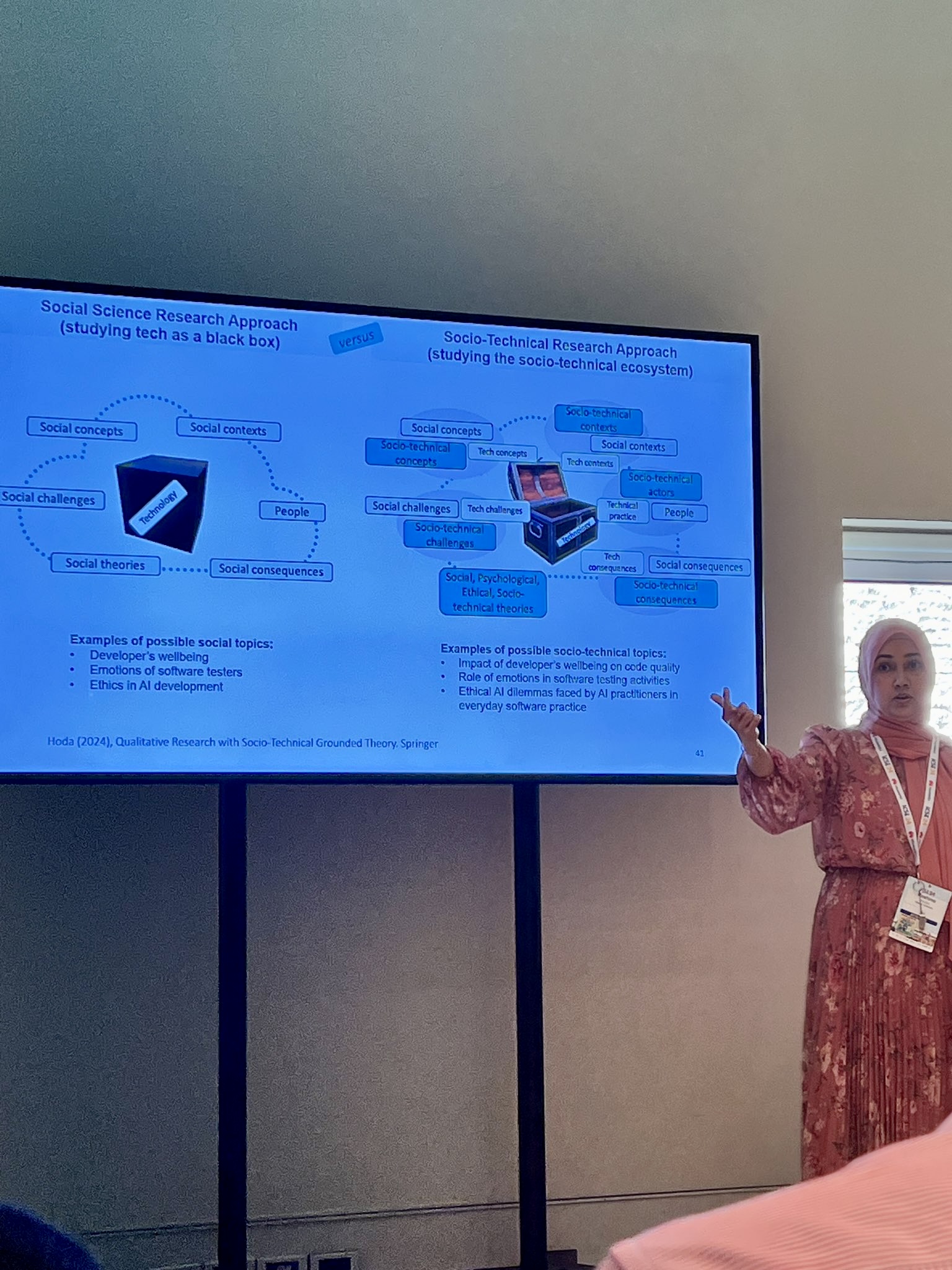
- STGT is based on an underlying socio-technical research framework which specifies the ST domain, ST phenomenon, ST researchers, and ST data, tools, and techniques. Traditional GT methods, on the other hand, apply a Social Science research framework which typically considers technical aspects with a black box approach.
- Traditional GT methods are designed to be applied in full for theory development. They do not support partial application for qualitative data analysis. STGT introduces two possible applications: (a) STGT for Qualitative Data Analysis to be used for analysing qualitative data in combination with other methods, e.g., within case studies, ethnography, or mixed methods research; and (b) Full STGT for theory development which includes the basic and advanced stages.
- While open coding is common to all GT methods, STGT applies an ST approach to open coding and explains how to code for ST phenomenon.
- Traditional GT methods support a specific research paradigm, e.g., Glasserian GT is mostly consider post-positivist, Strauss-Corbinian GT is best aligned with interpretivist, and Charmaz’s Constructivist GT applies an exclusive Constructivist approach. STGT, on the other hand, can be applied with any one of these paradigms through careful and consistent application.
- Other details can be found in the 2024 Springer Book and the TSE 2022 paper introducing STGT for SE.
 Rashina Hoda